

How to Maintain Emergency Preparedness Plans Year-Round
Last Updated: October 26, 2026
Quick Summary
Maintain emergency preparedness plans by giving them an owner, a calendar, and a version history: keep a short checklist, date and archive each revision, and run a quarterly review that takes under an hour. Update the plan within one week after any major life change, and turn every drill debrief into a corrective action with an owner and due date.
- Keep the core family checklist to nine lines; if it runs longer than a page, cut it.
- Name the master file with a date and save old versions in an Archive folder.
- Match tasks to cadence: check kit supplies monthly, run the full review quarterly, drill annually.
- During drills, time how long it takes to account for every household member.
- Simulate a network outage yearly with phones in airplane mode for 30 minutes.
Table of Contents
- Why Emergency Preparedness Plans Go Stale
- Build a Family Emergency Plan Checklist You Can Actually Maintain
- Set Up an Emergency Preparedness Plan Template With Version Control
- Run a Quarterly Emergency Plan Review Checklist
- Keep Your Family Emergency Communication Plan Current
- Test Readiness With Drills, Exercises, and Drills Debriefs
- Refresh Supplies, Equipment, and Emergency Systems
- Apply Lessons From Drills and Real Incidents
- Frequently Asked Questions
Why Emergency Preparedness Plans Go Stale
A plan you write once and file away is a wish.
Families often build a plan, then treat it as a finished project instead of a living document.
So how do you keep emergency preparedness plans usable year after year?
The good news: maintenance takes less time than building. A solid review cycle runs on a few hours a year.
Build a Family Emergency Plan Checklist You Can Actually Maintain
Most family emergency plan checklists fail because they are too long. A thirty-page binder feels thorough but gets ignored. The fix is a short core list you can keep current.
The Core Items Every Checklist Needs
Start with the essentials and nothing more:
- Every household member's name, birth date, and medical needs
- Current phone numbers for each person, including work and school
- Two meeting spots: one near home, one outside the neighborhood
That is it. Nine lines. If your checklist runs longer than a page, cut it.
For families who want a deeper walkthrough, our Survival Guide & Workbook: In Case of Emergency - Shelter-In-Place covers how to build a full plan without overcomplicating it.

Assigning Owners and Review Dates
A checklist with no owner is a checklist nobody updates. Give every line item a name and a date.
- Owner: the person responsible for keeping that item current
- Review date: the month it gets checked, written on the page
- Backup owner: someone who notices if the primary owner forgets
Split the load: one adult owns contacts and documents, another owns supplies and equipment, and older kids own their go-bags.
Set Up an Emergency Preparedness Plan Template With Version Control
An emergency preparedness plan template is a reusable document structure that standardizes what your plan contains and how changes get recorded.
This is the part almost every guide ignores. Do it anyway. It takes ten minutes.
How we would set it up:
- Create one master file, digital and printed.
- Name it with a date:
Family-Emergency-Plan-2026-10. - Add a revision log at the top with three columns: date, change, changed by.
- Save old versions in a folder called "Archive." Never overwrite the master.
- Print one copy for the go-binder and one for the refrigerator.
Watch out: multiple undated copies mean you will grab the wrong one under stress. One master, dated and archived, is the rule.
If you want a structured starting point, our Survival Guide & Workbook: In Case of Emergency - Shelter-In-Place walks you through organizing your plan step by step, so you are not building the template from scratch.
Run a Quarterly Emergency Plan Review Checklist
An emergency plan review checklist is a short, repeatable set of questions you run every quarter to confirm your plan still matches your life. It should take under an hour.
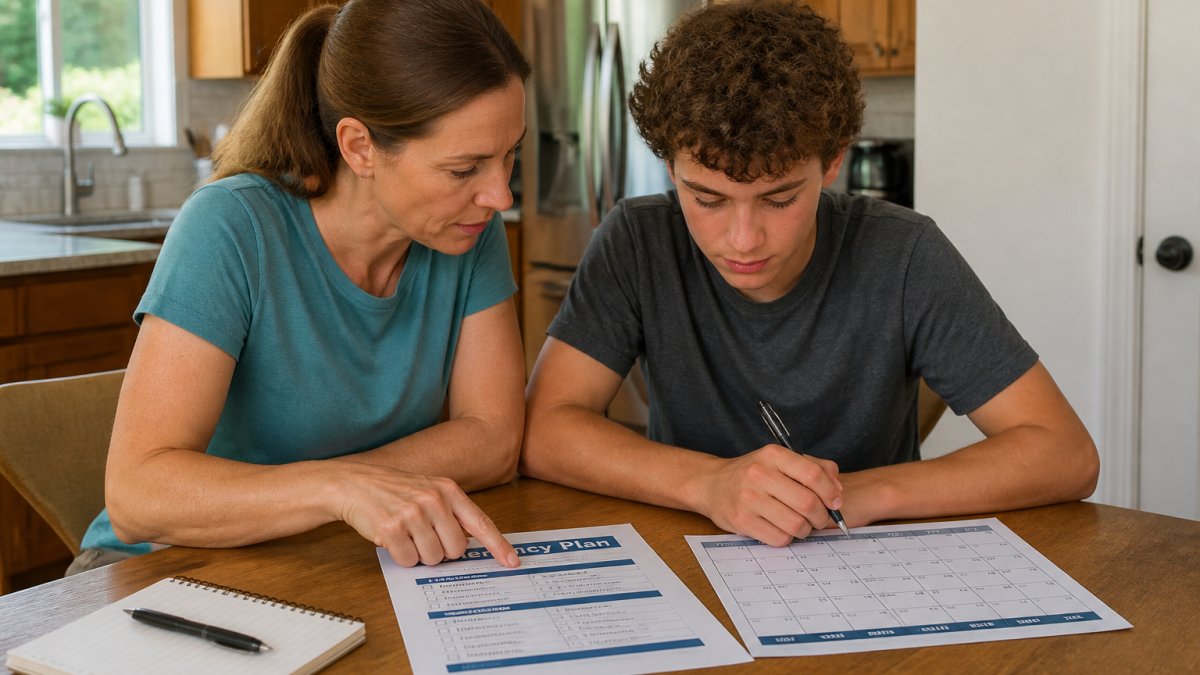
Run these checks each quarter, and record a pass or fail for each one:
- Are all phone numbers and emails still correct? (Verify by placing a test call or text to the out-of-area contact.)
- Has anyone moved, changed schools, or changed jobs?
- Are medications and dosages still accurate?
Monthly, Quarterly, and Annual Triggers
Not everything needs the same cadence. Match the task to the timeframe, and write the owner's name next to each row.
| Frequency | Task | Who Owns It | Pass Indicator |
|---|---|---|---|
| Monthly | Check kit water, food dates, batteries | Supplies owner | All items in date; no expired stock |
| Quarterly | Full plan review checklist | Plan owner | Every line item verified and signed |
| Annually | Full drill and document refresh | Whole household | Drill completed; revision log updated |
| As needed | Update after any major life change | Plan owner | Change logged within one week |
The "as needed" row is the one people miss. A new baby, job, move, surgery, or pet is a trigger to update the plan that same week, not at the next quarterly review.
Measure Readiness, Not Just Completion
A checked box tells you the review happened, not that the plan works. Add three measurable indicators to each quarterly review:
- Contact verification rate: the percentage of phone numbers and emails you actually confirmed, not just eyeballed. Aim for 100 percent, and note any you could not reach.
- Time to account for everyone: during the next drill, time how long it takes to confirm every household member's status. Record the number and watch whether it improves.
- Equipment inspection status: a simple pass or fail for each item (fire extinguisher gauge, smoke and carbon monoxide alarms, first aid kit, water and food dates). A single fail is a corrective action, not a note.
Event-Based Triggers Beyond the Calendar
Some changes do not wait for the quarter to turn. Add these triggers to the front of the plan so anyone in the household can act:
- A household member moves, changes jobs, or changes schools
- A new medication, diagnosis, or mobility need
- A new pet or a pet's changing needs
When a trigger fires, the plan owner updates the master, logs the change, and tells everyone within one week.
Keep Your Family Emergency Communication Plan Current
A family emergency communication plan is the agreed set of ways your household reaches each other when normal networks fail. It needs the same maintenance as everything else.
What most guides miss: cell networks congest fast in a real emergency. Text often gets through when calls do not. Build that into your plan.
Book: Survival Guide & Workbook: In Case of Emergency - Shelter-In-Place →
- Agree on one out-of-area contact everyone calls or texts
- Save that contact in every phone, labeled clearly
- Write the number on a card in every go-bag
For families spread across different states, the out-of-area contact matters even more. Our Survival Guide & Workbook: In Case of Emergency - Shelter-In-Place offers structured guidance for shelter-in-place preparedness, which includes communication planning.
Test Readiness With Drills, Exercises, and Drills Debriefs
A drill you never run is a plan you never tested. Testing finds gaps before an emergency does. But most guides stop at "run a drill and talk about it." The maintenance loop has three parts: the drill, the debrief, and a documented corrective action that changes the plan.
Keep drills short and real:
- Pick a scenario. Fire, power outage, or shelter-in-place.
- Set a timer. See how long it takes everyone to reach the meeting spot.
- Run it. No coaching mid-drill.
- Debrief right after. Ask three questions: What worked? What slowed us down? What do we change?
- Write it down. Add the changes to your revision log.
The debrief is the point. A drill without a debrief is just a fire alarm and some confusion. Twenty minutes of honest talk beats an hour of silent practice.
Turn Debriefs Into Corrective Actions
A debrief that ends with "we should fix that" changes nothing. Convert each finding into a corrective action with an owner and a due date, then verify it at the next review.
Use a simple corrective-action log with five columns:
| Finding | Change | Owner | Due Date | Verified |
|---|---|---|---|---|
| Meeting spot was blocked by parked cars | Move spot to the corner lot | Plan owner | Next week | Yes |
| Nobody could find the flashlight | Mount it by the back door | Supplies owner | This month | Yes |
| Out-of-area contact number was wrong | Update cards and phones | Communications owner | This week | Yes |
At the next quarterly review, open the log and confirm each row is verified, an unverified corrective action is not done. This loop keeps emergency preparedness plans sharp instead of stale: a plan that never changes after a drill is a plan nobody learned from.
Test Communications Failure, Not Just Evacuation
Most drills test movement; few test what happens when the phones do not work. Add a communications-failure scenario at least once a year:
- Simulate a network outage. Have everyone put phones in airplane mode for 30 minutes and see whether the plan still works using only the printed contact card and the agreed out-of-area contact.
- Check redundant alert channels. Confirm that at least two ways to receive alerts are working (for example, a weather radio and a phone-based alert), and that everyone knows where the radio is and how to power it.
- Verify offline copies. Make sure a printed copy of the plan and contact list lives in every go-bag and in the vehicle, and that the printed copy matches the current version.
Accessibility and Inclusion Checks
A drill that works for most of the household but not all of it is not a passing drill. Add these checks to at least one exercise per year:
- Can every household member, including anyone with a disability or mobility need, use the evacuation route unassisted or with the help the plan assigns?
- Are instructions available in a language every household member reads comfortably?
- Does the plan account for visitors, temporary workers, or guests who may be present during an emergency?
Record the results in the same corrective-action log. The goal is not a perfect drill but a plan that gets measurably better each time you test it.
Refresh Supplies, Equipment, and Emergency Systems
Supplies expire. Equipment fails. Systems drift. This is the maintenance work nobody enjoys and everybody needs.
Check these on a schedule:
- Water and food: rotate stock, check dates monthly
- Batteries and flashlights: test quarterly, replace yearly
- First aid kit: restock what you used, check expiration dates
Watch out: expired food and dead batteries give you false confidence. A kit you never open is a kit you cannot trust. Open it, use it, refill it.
For a full walkthrough on keeping kits in shape over the long haul, our Survival Guide & Workbook: In Case of Emergency - Shelter-In-Place provides actionable checklists for family safety, which can help with kit maintenance.
Apply Lessons From Drills and Real Incidents
Every drill, near-miss, and real incident is free information. The question is whether you capture it.
After any event, run a short review:
- What actually happened, in plain terms?
- Where did the plan help?
- Where did it fail or slow you down?
Then update the plan, log the change, and tell everyone. This is the loop that keeps emergency preparedness plans sharp instead of stale.
For a step-by-step approach to turning takeaways into action, our Survival Guide & Workbook: In Case of Emergency - Shelter-In-Place walks through the full process.
Most families build a plan once and let it gather dust.
Preppi Prepper exists to make that maintenance easier. Our Survival Guide & Workbook: In Case of Emergency - Shelter-In-Place gives you structured checklists to organize what you already have.
Get started with Preppi Prepper and turn your emergency plan into something you actually maintain.
Frequently Asked Questions
How often should you review an emergency preparedness plan?
Run a full review at least every six months, with a quick check every quarter. Update contact information, supply levels, and evacuation routes each time. Add a review whenever something changes: a new address, a new pet, a child starting school, or a job change. Put the dates on a shared calendar so the review does not get skipped. A short quarterly check catches small problems before they become gaps during an actual emergency.
What should be updated in a family emergency plan?
Update emergency contacts, meeting locations, evacuation routes, and the roles each person holds. Check that disaster supplies are within expiration dates and that emergency equipment like flashlights and radios still work. Confirm school and workplace contact information. Review individual needs such as medications or mobility support. Then note what changed, who changed it, and the date, so the next review starts from an accurate version of the plan.
How do you practice an emergency plan with your family?
Schedule a short drill twice a year. Walk through the evacuation route, practice the shelter-in-place steps, and have everyone text or call the out-of-area contact. Time how long it takes to gather and note what slowed you down. After the drill, hold a five-minute debrief and write down one or two fixes. Add those fixes to your emergency plan review checklist so the next drill tests whether the change worked.
How do you keep emergency contact information current?
Store contacts in one place, such as a printed card in your go-bag and a shared digital document. Assign one person to confirm every number and email each quarter. Include an out-of-area contact, since local lines can fail during a disaster. When someone changes a phone number or moves, update the card and the digital copy the same day, and log the change date so you can see how fresh the list is.
