

How to Secure Home Disasters: A 2026 Preparedness Guide
Table of Contents
- Start with a Room-by-Room Hazard Assessment
- How to Secure Home Disasters with Structural Reinforcement
- Essential Items for Shelter in Place
- How to Protect Important Documents from Fire and Flood
- Build Your Home Emergency Preparedness Checklist
- Audit Your Insurance and Plan for Financial Recovery
- Common Mistakes That Leave Homes Vulnerable
- Frequently Asked Questions
Last Updated: September 30, 2026
Start with a Room-by-Room Hazard Assessment
Learning how to secure home disasters starts with one honest walk through your house: a room-by-room check for what can hurt you or break during a storm, quake, or flood. It takes about an hour.
Walk each room and note four things:
- Heavy items sitting above head height
- Furniture that isn't attached to a wall
- Windows and doors that could fail
- Utilities you'd need to shut off fast
How to Secure Home Disasters with Structural Reinforcement
Structural reinforcement keeps your house standing and your family safe inside it, covering doors, windows, garage openings, and heavy items that can fall.
Doors, Windows, and Garage Openings
Your garage door is usually the weakest point in the house. High winds and flying debris find it first. Once it fails, inside pressure equalizes with outside pressure, and the roof can lift off.
Reinforce openings with these steps:
- Add vertical bracing to the garage door, or install a rated wind-load garage door with horizontal and vertical reinforcement
- Install deadbolts on all exterior doors, and add a third hinge or heavy-duty strike plate so the door resists being pushed in
- Fit storm shutters or cut plywood panels for windows
- Check that door frames are anchored into the wall studs, not just the trim
Securing Heavy Furniture and Appliances
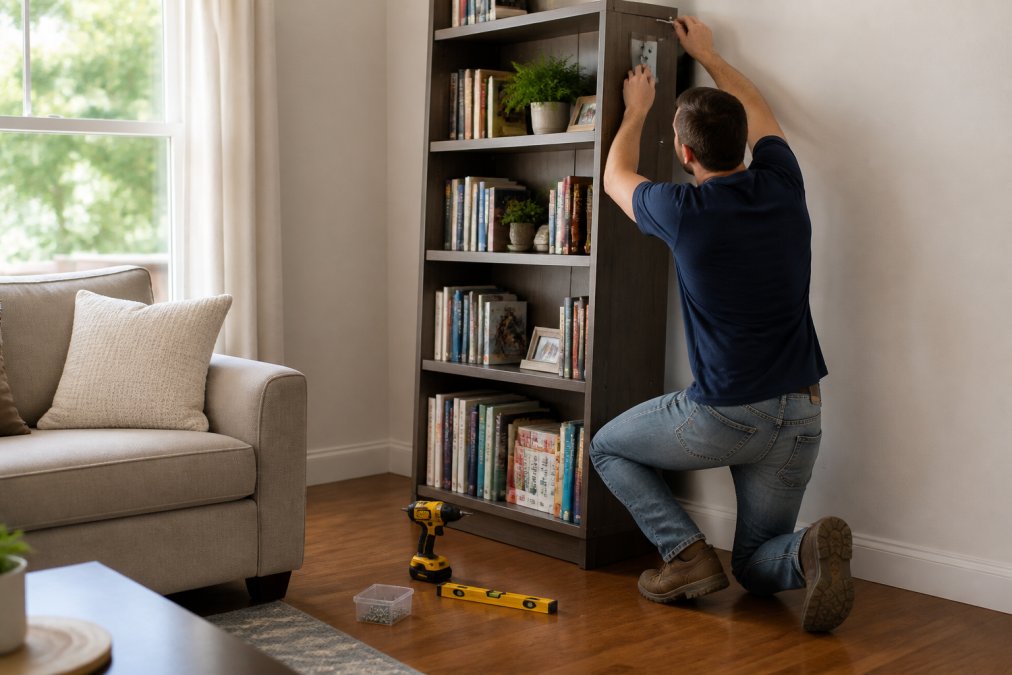
Anything taller than your waist should be anchored, bookcases, dressers, TVs, the fridge. Use metal L-brackets or nylon straps rated for the weight, screw into studs (never drywall alone), and keep heavy items on low shelves.
- Find the stud. Mark each stud's center with painter's tape before drilling. A bracket that misses the stud fails.
- Match the fastener to the load. A 2-inch lag screw into a stud holds far more than a plastic anchor. For tall bookcases, two brackets near the top and two near the bottom spread the load.
- Strap the water heater. Two metal straps, one around the upper third and one around the lower third, anchored into studs, keep a 40- to 50-gallon tank from tipping. A flexible gas connector and a braided water supply line reduce the chance of a broken line if the tank does move.
- Secure the fridge and stove. Heavy enough to walk during a quake, they stay put with a strap or bracket kit that also protects the gas and water connections behind them.
- Anchor the TV. A flat-screen on a stand is a tipping hazard; a wall mount or safety strap rated for its weight solves it.
Utility Bracing and Shut-Off Access
Reinforcement isn't only about furniture. The systems bringing gas, water, and power into the house cause the most secondary damage after the shaking or wind stops.
- Water heater: strap it as described above, and replace a rigid gas line with a flexible connector where code allows.
- Gas meter and main valve: know the shut-off and keep a dedicated wrench zip-tied to the meter or in your emergency kit. Only shut off gas if you smell or hear it escaping, and let the utility turn it back on.
- Electrical panel: label every breaker so you can kill power to a flooded area fast. A main breaker you can find in the dark is worth more than a flashlight.
- Water main: find the shut-off, usually near the street or where the line enters the house, and test that the valve actually turns. A valve that has not moved in ten years may not move when you need it.
Essential Items for Shelter in Place
Essential items for shelter in place let your family stay put safely for at least two weeks: water, food, first aid supplies, light, and communication gear.
Your kit should include:
- One gallon of water per person per day
- Non-perishable food and emergency rations
- A first aid kit and any prescription meds
- Battery-operated or hand-crank emergency lighting
- A battery-powered or hand-crank radio
- CO detectors and a fire extinguisher
- A waterproof container for copies of key documents
Food, Water, and Emergency Rations
Water storage and treatment.
- Store water in food-grade containers. A cleaned 2-liter soda bottle works; a milk jug does not, because the plastic breaks down and the residue feeds bacteria.
- Keep a case or two of sealed bottled water for drinking and reserve larger containers for washing and flushing.
- If you run out, boil questionable water for at least one minute, or use unscented household chlorine bleach at about 8 drops per gallon, letting it stand 30 minutes. Bleach loses potency, so check the date.
- A gravity-fed or pump filter rated for pathogens gives you a second option that needs no fuel or bleach.
Food that actually stores.
A practical two-week pantry for one adult looks like:
- 6 to 8 cans of protein (beans, tuna, chicken)
- 4 to 6 cans of vegetables and fruit
- 2 jars of peanut butter or nut butter
- 2 to 3 pounds of rice or pasta
- 1 box of energy or granola bars
- 1 jar of honey or a bag of sugar for calories and morale
- Instant coffee or tea if you drink it
Rotation is the whole system.
ready.gov build a kit guidance lists the full recommended supply set and a printable checklist you can tape inside the closet door.
How to Protect Important Documents from Fire and Flood
Protecting important documents from fire and flood means physical storage and digital copies: a fireproof safe handles the first, a cloud backup the second.
Book: Survival Guide & Workbook: In →
Start with these documents:
- Birth certificates and Social Security cards
- Passports and immigration papers
- Insurance policies and deeds
- Medical records and prescriptions
- Financial account information
Digital Disaster Proofing and Cloud Backup
Digital disaster proofing is the step most preparedness guides skip. It's also the one that saves you weeks of paperwork after a disaster.
Then protect the accounts themselves:
- Turn on two-factor authentication everywhere
- Save recovery codes somewhere offline
- Share access with one trusted family member
Build Your Home Emergency Preparedness Checklist
A home emergency preparedness checklist turns your plan into repeatable action. Build it once, then review it every six months.
Here's the structure that works:
| Section | What to Include | Review Frequency |
|---|---|---|
| Hazard assessment | Room-by-room notes and photos | Every 6 months |
| Structural fixes | Anchors, braces, deadbolts | Annually |
| Supply kit | Water, food, meds, lighting | Every 6 months |
| Documents | Fireproof safe, cloud copies | Annually |
| Communication plan | Contacts, meeting spots | Every 6 months |
| Insurance | Policy review and receipts | Annually |
Family Communication Plan and Evacuation Routes
A family communication plan is a written agreement on who calls whom, where you meet, and how you check in. It matters most when phones are down and family members are apart.
Write down:
- One out-of-state contact everyone calls
- Two meeting spots: one near home, one outside the neighborhood
- A text-first rule, since texts often get through when calls don't
- School and workplace pickup procedures
Audit Your Insurance and Plan for Financial Recovery
Most homeowners find out what their policy covers after the storm, the worst possible time. An insurance audit takes an afternoon and can save you thousands.
Call your agent and ask four questions:
- Does my policy cover replacement cost or actual cash value?
- Is flood damage covered, or do I need a separate policy?
- What's my deductible for wind and storm damage?
- Are there caps on specific categories like electronics or jewelry?
Common Mistakes That Leave Homes Vulnerable
The same mistakes show up in home after home. Fix these and you're ahead of most households.
- Buying gear before assessing risk. You end up with three flashlights and no water.
- Anchoring to drywall instead of studs. Brackets fail under real load.
- Skipping the garage door. It's the first thing to fail in high wind.
- Storing documents in one place. Fire and flood take both at once.
- Never practicing the plan. A plan nobody has walked through isn't a plan.
- Forgetting digital accounts. Locked-out email means locked-out records.
- Assuming insurance covers everything. Flood and quake usually need separate policies.
Frequently Asked Questions
How do I prepare my home for a disaster?
Start with a room-by-room hazard assessment to identify loose items, unsecured furniture, and utility shut-off points. Then reinforce doors and windows, anchor heavy furniture to wall studs, and store emergency supplies. Build a home emergency preparedness checklist that covers food, water, first aid, and copies of important documents. Practice your family communication plan and evacuation routes twice a year so everyone knows what to do when a disaster strikes.
What are the essential items for shelter in place?
Your shelter-in-place kit needs at least one gallon of water per person per day for three days, non-perishable food, a battery-operated or hand-crank radio, flashlights, extra batteries, a first aid kit, medications, and hygiene supplies. Include a waterproof container for copies of IDs and insurance policies. Add emergency lighting, a whistle, duct tape, and plastic sheeting. A survival guide and workbook can help you organize these supplies.
How can I protect important documents from natural disasters?
Store birth certificates, passports, deeds, and insurance policies in a fireproof safe or a waterproof container. Make digital copies and back them up to encrypted cloud storage or an external drive kept off-site. For documents you need quickly during an evacuation, keep a grab-and-go folder in a sealed bag. Review your document inventory annually and update it after any major life change, such as a move or new policy.
What structural reinforcements are needed to disaster-proof a home?
Install deadbolts and reinforced strike plates on exterior doors, add storm shutters or pre-cut plywood boarding for windows, and brace garage doors if you live in a high-wind area. Anchor bookshelves, water heaters, and large appliances to wall studs. In earthquake zones, seismic retrofitting may include bolting the foundation and bracing cripple walls. A licensed contractor can assess your home's structural integrity and recommend the right reinforcements for your region.