

How to Store Water for Emergencies: A Step-by-Step Guide
Table of Contents
- How Much Water to Store Per Person
- Best Water Storage Containers for Preppers
- How to Purify Water for Drinking
- Your Water Rotation Schedule
- Space-Saving Water Storage for Apartments
- Sanitizing and Maintaining Your Containers
- Frequently Asked Questions
Last Updated: September 25, 2026
How Much Water to Store Per Person
The standard recommendation is to store water at one gallon of potable water per person per day for drinking and basic sanitation, per federal emergency guidance. A family of four needs four gallons daily, or 28 gallons for a one-week supply.
Calculating Your Household's Total Water Volume
Add up everyone in your home, multiply by one gallon, then by your planned days. Three days is the minimum; two weeks is the target if space and budget allow.
Here's the volume math for common household sizes:
Household Size |
3-Day Supply |
2-Week Supply |
|---|---|---|
1 person |
3 gallons |
14 gallons |
2 people |
6 gallons |
28 gallons |
4 people |
12 gallons |
56 gallons |
6 people |
18 gallons |
84 gallons |
The Weight and Structural Load of Stored Water
Water weighs about 8.3 pounds per gallon. A 14-gallon supply for one person weighs roughly 116 pounds. A 55-gallon drum, full, weighs over 450 pounds.
Best Water Storage Containers for Preppers
The best containers are food-grade, BPA-free, and sized so you can actually lift them when full. That last criterion eliminates more options than most buyers expect.
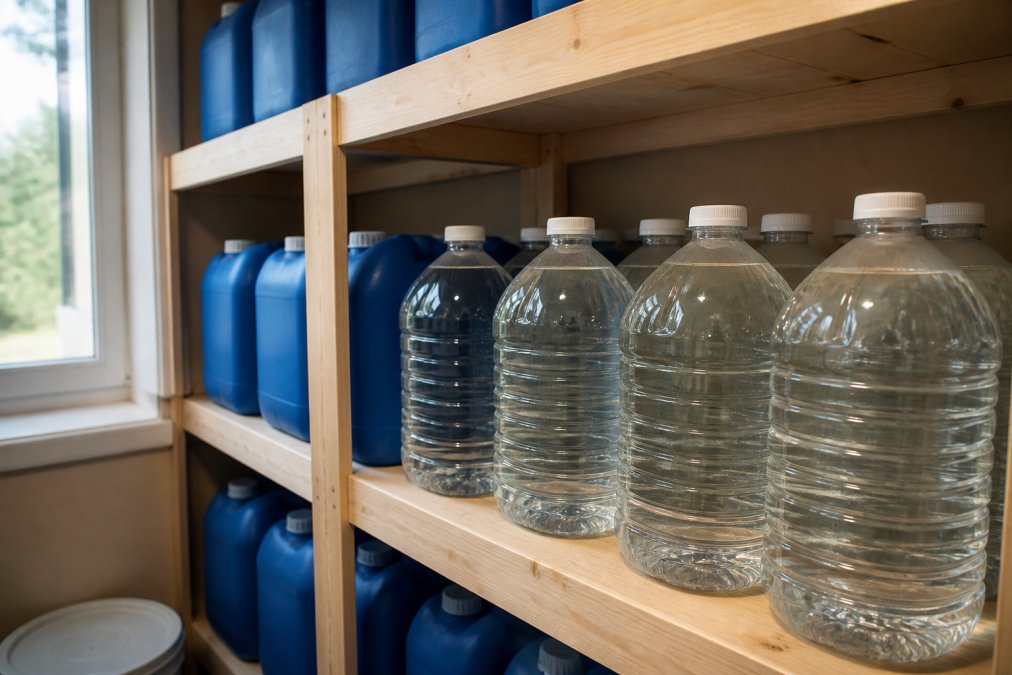
Food-Grade Plastic and BPA-Free Options
Food-grade plastic is manufactured to hold consumables without leaching harmful chemicals. Look for the recycling codes and "food grade" labeling, and avoid any container that previously held chemicals, cleaners, or fuel, no matter how well you wash it.
The practical shortlist:
- Stackable rigid jugs (5-7 gallons): Best for households with storage space. Heavy when full, so keep them at floor level.
- Collapsible containers: Empty down to almost nothing, which makes them the apartment pick. Less durable over repeated fills.
- Glass carboys: Excellent for water quality, terrible for portability. Reserve for a permanent, protected location.
- Pouches and flexible bladders: Lightweight and space-efficient, but prone to pinhole leaks if stored against rough surfaces.
How to Purify Water for Drinking
Purification means treating water to remove or kill pathogens so it's safe to drink. Already-treated tap water generally doesn't need purification before storage, but treat it if the source is questionable or the water has sat a long time.
Three methods cover most situations:
- Boiling: Bring water to a rolling boil for at least one minute. Kills bacteria, viruses, and parasites. Doesn't remove chemical contamination.
- Bleach disinfection: Use plain, unscented household chlorine bleach with no additives. The Centers for Disease Control and Prevention's guidance on making water safe publishes the correct ratio for your concentration, and getting that ratio right matters more than most people assume.
- Filtration and purification devices: Portable filters handle sediment and many pathogens. Purifiers add chemical or UV treatment to catch what filters miss.
Water Filtration vs. Water Purification
Filtration physically strains out particles and organisms above a certain micron size, sediment, protozoa, and most bacteria, but doesn't reliably remove viruses, dissolved chemicals, or heavy metals.
Reviving Stored Water That's Gone Stale
Water doesn't spoil like food, but it goes flat and picks up odors. Over months in a sealed container, dissolved oxygen escapes (changing the taste) and trace organic matter can support slow microbial growth if the container wasn't perfectly sanitized.
Sourcing Water During a Disaster
Stored water runs out. Know where the next gallon comes from before you're thirsty.
Inside the home:
- Water heater: A typical residential tank holds 40-50 gallons. Shut off the gas or power first, let it cool, then drain from the bottom valve. Treat it as questionable and purify before drinking.
- Toilet tank (not the bowl): The upper tank holds clean water if you haven't added chemical cleaners. Never use water from the bowl.
- Ice maker and ice trays: Melt and use. Ice made before the outage is generally safe.
- Pipes: Open the highest faucet in the house to let air in, then drain from the lowest faucet. This recovers the water sitting in your plumbing.
- Canned goods and bottled drinks: The liquid in canned fruit and vegetables is drinkable and counts toward your daily intake.
Outside the home:
- Rainwater: Collect with clean tarps or food-grade containers. Treat before drinking.
- Natural sources: Rivers, streams, and lakes are almost always contaminated with pathogens. Filter, then purify. Never drink untreated surface water.
- Swimming pools and hot tubs: Chemically treated and not safe to drink without distillation. Skip them for drinking and reserve for sanitation only.
Your Water Rotation Schedule
The water you store water doesn't last forever. Commercially sealed water holds quality longest, often well past a year if stored properly. Self-filled water from a treated municipal source is best rotated every six months; untreated or questionable water should be treated and used within days.
A rotation checklist:
- Label every container with the fill date in permanent marker
- Rotate self-filled containers every six months
- Check commercial bottles against their printed date
- Inspect each container for cloudiness, odor, or algae
- Re-sanitize any container you empty before refilling
- Log the rotation date so you know the schedule held
How to Verify Stored Water Is Still Safe
Most guides tell you to rotate on a schedule and trust the calendar. That's a guess, not verification: a hairline crack, a failed seal, or a missed spot in sanitizing can turn the water bad before the rotation date arrives.
What to test for and what the results mean:
- Coliform bacteria: Any positive result means discard the container, sanitize it, and refill. Do not drink the water.
- pH: Drinking water should sit between 6.5 and 8.5. A reading outside that range doesn't necessarily mean the water is unsafe, but it can indicate contamination or container degradation.
- Chlorine residual: If you treated with bleach, a residual reading confirms the dose was adequate. Zero residual after treatment means the treatment didn't take.
- Total dissolved solids (TDS): A TDS meter won't tell you if water is safe, but a sudden jump from your baseline reading suggests the container is leaching or the water has picked up contaminants.
Rotation Schedule by Container Type
Different containers age at different rates, and the rotation interval should match.
Container Type |
Rotation Interval |
Notes |
|---|---|---|
Commercially sealed bottled water |
Check printed date; often 1-2 years |
Longest shelf life; rotate when date approaches |
Food-grade rigid jugs (5-7 gal) |
Every 6 months |
Inspect seals and caps each cycle |
Collapsible containers |
Every 3-6 months |
Thinner material; check for pinhole leaks |
Glass carboys |
Every 6-12 months |
Best water quality retention; fragile |
Flexible bladders and pouches |
Every 3 months |
Highest leak risk; inspect seams |
Repurposed soda bottles |
Every 1-2 months |
Not designed for long-term storage; use as backup only |
What to Do When Water Fails Inspection
If a container fails, cloudy water, off smell, positive bacteria test, or a visible crack, the water isn't salvageable for drinking. Don't boil it and hope: boiling kills pathogens but won't remove chemical byproducts of microbial growth or plasticizers leached from a degrading container.
Space-Saving Water Storage for Apartments
Apartment dwellers face real constraints: less square footage, upper floors, and often lease rules against modifications. You don't need a garage to store a meaningful supply.
Where to hide water without wrecking your living space:
- Under beds: Flat, low-profile containers slide beneath a bed frame and stay out of sight.
- Closet floors: Line the back wall of a closet with rigid jugs. Keep them low so you're not lifting overhead.
- Behind furniture: The dead space behind a couch or bookshelf holds more than you'd think.
- Top shelves, used carefully: Only for light, sealed containers. Never load heavy water above head height.
- Freezer space: Partially filled containers serve double duty as described above.
Sanitizing and Maintaining Your Containers
Clean containers are the difference between stored water and a biology experiment. Sanitize every container before its first fill and after every rotation.
The process:
- Wash the container with warm water and mild dish soap.
- Rinse thoroughly to remove all soap residue.
- Sanitize with a diluted unscented bleach solution, using the ratio published by the CDC for your bleach concentration.
- Rinse again with clean water.
- Air dry completely before filling. Residual moisture encourages growth.
Frequently Asked Questions
How long can I store water for an emergency?
Commercially bottled water typically has a shelf life of one to two years, though it can last longer if stored properly. For water you treat and store yourself, aim to replace it every six months. The key is a consistent water rotation schedule: date every container and cycle through them before they expire. Store water in a cool, dark place away from chemicals and direct sunlight to maximize its shelf life.
Should I treat tap water before storing it for emergencies?
If your tap water is already treated and safe to drink, you do not need to add anything before storing it. However, sanitizing your containers first is critical. For water from untested sources, such as a well or stream, treat it before storage. You can purify it by bringing it to a rolling boil for one minute or by using unscented household bleach. Proper treatment prevents waterborne pathogens from growing while it sits.
Where is the best place to store water in my home?
Choose a cool, dark, and dry location, like a basement or an interior closet. Keep water away from direct sunlight, which can degrade plastic containers and encourage algae growth. Avoid storing water near gasoline, pesticides, or other chemicals, as vapors can seep through plastic. If you live in an apartment, use the bottom of closets or under beds. Always place containers on a sturdy shelf or the floor to handle the weight.
How do preppers store large volumes of water without it going bad?
Preppers use a combination of large, food-grade drums and smaller, portable containers. They treat water before storage, often with bleach or purification tablets, and seal containers tightly. The secret is rotation: they date everything and use the oldest water first. Some also invest in water quality testing kits to check for contamination. For long-term storage, they keep water in a temperature-controlled, dark environment to prevent bacterial growth.