

How to Order a Home Emergency Planning Kit
Table of Contents
- Why Ordering a Home Emergency Planning Kit Beats Piecemeal Prep
- What You'll Need Before You Order
- Step 1: Build Your Emergency Supply Checklist for Home
- Step 2: How to Store Water for Emergencies
- Step 3: Choose Between DIY and Pre-Packaged Kits
- Step 4: Customize Your Kit for Family Needs
- Step 5: Set Up an Emergency Kit Maintenance Schedule
- Where to Order a Home Emergency Planning Kit
- Frequently Asked Questions
Last Updated: October 4, 2026
Why Ordering a Home Emergency Planning Kit Beats Piecemeal Prep
You can order a home emergency planning kit in about 15 minutes once you know what belongs in it. This guide from Preppi Prepper walks you through every step, from your emergency supply checklist for home to a maintenance schedule you'll actually follow.

Scattered prep is the default for most families: a flashlight in the junk drawer, half a first aid kit in the car, three water bottles in the pantry.
The FEMA guidance on building a kit recommends every household keep a three-day supply minimum. We'd argue for more if you have kids, pets, or anyone with medical needs.
What You'll Need Before You Order
Before you order anything, take inventory of what you already have. Most households own more emergency supplies than they realize. The goal is to fill gaps, not start from zero.
Gather these details first:
- Household size and ages. Every person changes your water, food, and medication math.
- Medical needs. Prescriptions, inhalers, epinephrine, insulin storage.
- Pet count. Pets need water, food, and waste supplies too.
Write all of this down for Step 1.
Step 1: Build Your Emergency Supply Checklist for Home
An emergency supply checklist for home should cover water, food, first aid, light, communication, shelter, and hygiene. Build it around your household size, then buy to fill the gaps from your inventory.
Here's the core checklist we recommend:
- Water: one gallon per person per day
- Non-perishable food: three days minimum
- Manual can opener
The American Red Cross survival kit checklist covers the same ground and is worth cross-checking against your list.
Essential Items for Emergency Kits
Essential items for emergency kits fall into two groups: life-sustaining (water, food) and situation-managing (light, communication, sanitation). Don't skip the boring items, a working flashlight matters more than a fancy survival knife, and a printed contact list matters more than an untested solar charger.
First Aid Kit Components
First aid kit components should match your household's actual risk. A family with toddlers needs different supplies than a household of adults.
At minimum, include:
- Adhesive bandages in multiple sizes
- Sterile gauze pads and rolled gauze
- Medical tape
Check expiration dates every six months. Expired supplies get replaced, not ignored.
Step 2: How to Store Water for Emergencies
Knowing how to store water for emergencies comes down to quantity, container, and rotation: one gallon per person per day, food-grade containers, rotated every six months. Commercial bottled water works fine, as do food-grade storage containers, but never milk jugs, old soda bottles, or anything that held a non-food liquid.
For a family of four, that's 12 gallons for three days (the CDC). If you have pets, add another half-gallon per pet per day.
Step 3: Choose Between DIY and Pre-Packaged Kits
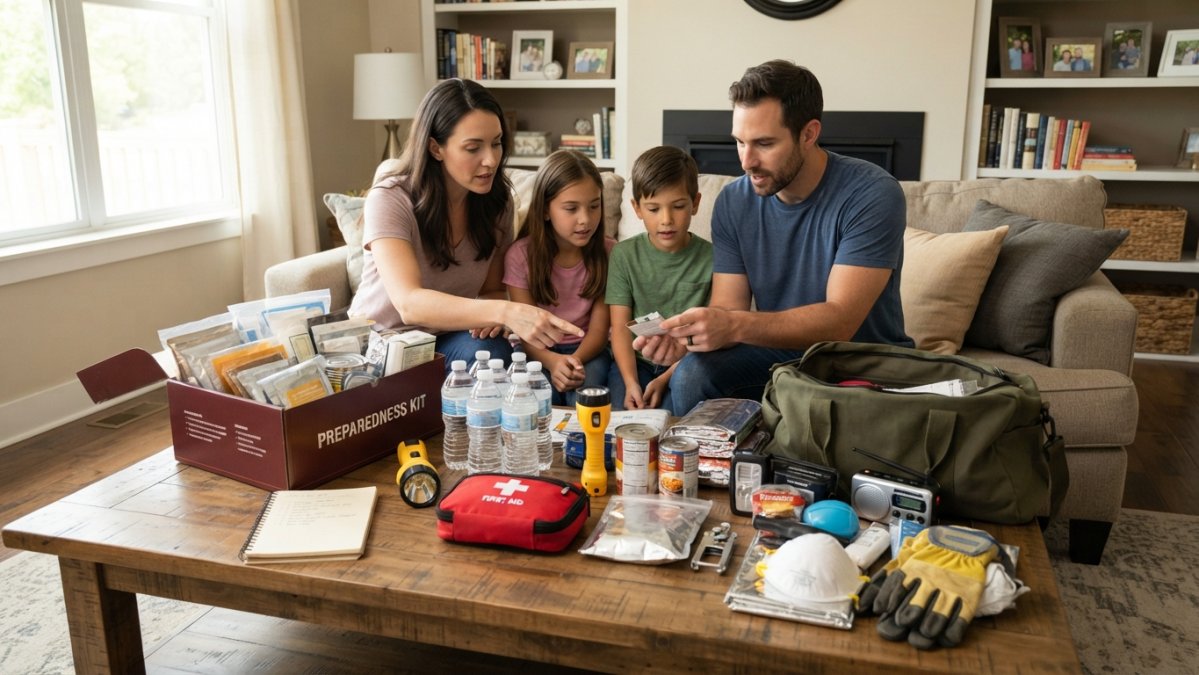
DIY and pre-packaged kits both work; the right choice depends on your time, budget, and confidence you'll finish building one. The cheapest kit is the one you actually complete and maintain, not the one with the lowest sticker price.
| Factor | DIY Kit | Pre-Packaged Kit |
|---|---|---|
| Upfront cost | Lower per item, higher in total trips | Higher per item, one transaction |
| Time to assemble | Several hours plus multiple store runs | Minutes |
| Customization | Full control | Limited, then add-ons |
| Quality consistency | Varies by item | Standardized |
| Maintenance | You track everything | Often comes with a checklist |
| Hidden cost | Duplicates and gaps from unplanned buying | Items you'll never use |
| Best for | Hands-on households with storage space | Busy families, first-timers, small apartments |
The Cost-Per-Item Reality
Pre-packaged kits carry a convenience premium: item by item, the water, food bars, flashlight, and first aid supplies inside usually cost more than buying those same items individually at a big-box retailer, you're paying for curation, packaging, and someone else doing the checklist. That premium isn't automatically a bad deal if assembling a complete kit means four store trips, two online orders, and a weekend of research.
Where DIY Kits Quietly Fail
DIY kits fail in predictable ways. The three most common gaps:
- Water rotation. People buy water once and never rotate it. Bottled water has a shelf life and needs replacing on a schedule.
- Document copies. Physical and digital copies of IDs, insurance, and medical records are the item most DIY kits skip entirely.
- Batteries. A flashlight without working batteries is a paperweight. DIY kits rarely include a battery rotation plan.
Pre-packaged kits fail differently: filler items you'll never touch, and food and water with shorter shelf lives than the marketing implies. Check expiration dates on arrival, not six months later.
A Hybrid Approach That Actually Saves Money
The most cost-effective path for most households is a hybrid: buy a pre-packaged base kit for items where curation matters (first aid, water, food bars), then add personal items separately, they're almost always cheaper individually because they're specific to your household:
- Prescriptions and over-the-counter medications you already use
- Pet food, leash, and waste bags sized to your pet
- Kids' comfort items and activities
This gets you a curated base without paying a premium for generic add-ons you'd rather choose yourself.
Before you buy either option, list the ten items you already own. Most households already have a flashlight, a basic first aid kit, and some bottled water. Subtracting those from your shopping list is the single fastest way to cut kit cost.
A Quick Decision Framework
Answer three questions:
- Do you have four or more hours to assemble a kit this month? If no, buy pre-packaged.
- Do you have specific medical, pet, or dietary needs? If yes, buy pre-packaged and customize, or build DIY around those needs.
- Is your storage space tight? If yes, pre-packaged kits are usually more compact and stackable than a DIY assortment.
If you answered no, no, no, a DIY kit will save you money and give you full control. Any other combination points toward pre-packaged plus add-ons.
Book: Survival Guide & Workbook: In Case of Emergency - Shelter-In-Place →
Step 4: Customize Your Kit for Family Needs
Customization is where a generic kit becomes your kit. Most guides stop at diapers and pet food. The gap almost every competitor misses is psychological first aid: the supplies and routines that keep your household calm, oriented, and functional during a disaster, not just alive.
Physical Customization by Household Member
Start with the practical layer:
- Kids: Comfort items, extra snacks, diapers, formula, activities to reduce boredom
- Pets: Food, water, leash, carrier, vaccination records, waste bags
- Medical: Extra prescriptions, cooling pack for insulin, hearing aid batteries
That last one matters more than people think. If your family is spread across different states, your emergency communication plan needs a designated out-of-area contact everyone checks in with. Local phone lines jam during regional disasters. Long-distance lines often stay open.
Write the plan down. Print it. Put a copy in every kit and one on the fridge.
The Layer Most Kits Skip: Psychological First Aid
Disasters are stressful, and stress degrades decision-making: children act out or shut down, adults freeze, and pets pick up on the tension. A kit that addresses only physical needs leaves your household functional on paper but not in practice. Psychological first aid isn't therapy, it's simple supplies and routines that help people stay oriented and calm in the first 72 hours:
- Orientation aids. A printed daily schedule, a wall clock, and a written list of what happens next. When routines break, structure reduces panic.
- Comfort items. A favorite blanket, stuffed animal, book, or photo for each child. Familiar objects anchor kids when surroundings change.
- Information control. A battery or hand-crank radio so you can get updates without doomscrolling on a dying phone. Knowing what's happening is itself a stress reducer.
Comfort Items for Kids and Pets
For children, the goal is familiarity: pack one comfort item per child plus a small activity that doesn't need power, and rotate the activity every six months so it stays novel. For pets, comfort looks different, a familiar blanket or toy, an acclimated carrier, and their normal food all reduce stress. A pet that won't eat or stay in a carrier is a pet you can't evacuate with easily, so practice carrier time before you need it.
A Simple Stress-Management Routine
You don't need a formal mental health plan, just three habits:
- Check in out loud. Once or twice a day, ask each person how they're doing. Naming feelings reduces their grip.
- Keep one routine. A consistent mealtime, bedtime story, or morning walk if it's safe.
- Limit news exposure. Get updates on a schedule, not continuously, constant alerts raise stress without adding useful information.
Ask each family member to pick one comfort item for the kit. Letting them choose builds ownership and makes the kit feel like theirs, which means they'll actually remember where it is.
Step 5: Set Up an Emergency Kit Maintenance Schedule
An emergency kit maintenance schedule separates a kit that works from one that's expired, disorganized, or missing half its contents when you need it.
Set two recurring reminders:
Every six months:
- Check expiration dates on food, water, and medications
- Replace batteries in flashlights and radios
- Update document copies
Every twelve months:
- Full inventory against your checklist
- Test all electronics
- Review and update your family emergency plan
Here's a simple template you can copy:
| Task | Frequency | Time Needed |
|---|---|---|
| Check expiration dates | Every 6 months | 20 minutes |
| Replace batteries | Every 6 months | 10 minutes |
| Update documents | Every 6 months | 15 minutes |
| Full inventory | Annually | 45 minutes |
| Test electronics | Annually | 15 minutes |
| Review family plan | Annually | 30 minutes |
Pair the check with something you already do twice a year, like changing smoke detector batteries or adjusting clocks for daylight saving. That habit anchor makes the schedule stick.
For families who want structure, the Preppi Prepper Survival Guide & Workbook: In Case of Emergency - Shelter-In-Place gives you a daily planner format and preparedness journal to track your kit, your plan, and your check-ins.
Where to Order a Home Emergency Planning Kit
You can order a home emergency planning kit from big-box retailers, dedicated preparedness brands, or specialty shops. Big-box stores offer convenience and low prices but generic kits; specialty preparedness retailers offer better-curated kits but cost more.
Wherever you order from, check three things before you buy:
- Contents list. Does it cover water, food, first aid, light, and communication?
- Shelf life. How long until the food and water expire?
- Return policy. Can you swap items you don't need or already own?
If you want a structured way to organize what you already have, the Preppi Prepper workbook pairs well with any kit you order, giving you the checklists and planning pages most kits don't include.
One more thing: tell your household where the kit lives. A kit nobody can find is just a box, so walk everyone through its location and contents once a year.
Frequently Asked Questions
What should be in a basic home emergency kit?
A basic home emergency kit should include water (one gallon per person per day for at least three days), non-perishable food, a battery-operated radio, flashlight, first aid supplies, whistle, dust mask, and sanitation items. FEMA also recommends including a multi-tool, emergency blanket, and copies of vital documents. For shelter-in-place scenarios, add plastic sheeting and duct tape. Preppi Prepper's Survival Guide & Workbook provides a structured checklist to ensure you don't miss anything critical.
How often should you update your home emergency supplies?
Check your emergency kit every six months. Replace expired food and water, test batteries in flashlights and radios, and rotate medications. A formal emergency kit maintenance schedule helps you stay on track. Set calendar reminders for April and October, and use a workbook like Preppi Prepper's to log expiration dates and inventory. After any disaster or power outage, restock used items immediately.
Is it better to buy a pre-made emergency kit or build your own?
Pre-made kits save time and ensure you have the essentials, but they may not fit your family's specific needs. Building your own lets you customize for dietary restrictions, children, pets, and medical conditions. Many people combine both: start with a pre-packaged kit, then add personal items. Preppi Prepper's Survival Guide & Workbook helps you organize what you already own and fill gaps efficiently, whether you buy or build.
Where is the best place to store an emergency kit at home?
Store your emergency kit in a cool, dry place that's easy to access, such as a hall closet, garage shelf, or basement. Avoid areas prone to flooding or extreme temperatures. For shelter-in-place scenarios, keep a smaller kit on each floor, especially near where you sleep. Ensure all family members know the location. If you live in an apartment, use a storage bench or under-bed bin to save space without sacrificing accessibility.
Most families mean to get prepared and never quite do it. The kit stays on a list, the plan stays unwritten, and the checklists never get made. Preppi Prepper exists to close that gap. Our survival guide and workbook for shelter-in-place scenarios gives you actionable checklists, structured planning pages, and a maintenance system you can actually keep up with. Subscribe to our emails for practical preparedness guidance, and start building a plan your family can rely on.