

How to Build a Long Distance Family Communication Plan
Last Updated: October 28, 2026
Quick Summary
Build a long distance family communication plan around three separate channels: a group text thread, a voice call tree, and an out-of-area contact who relays messages between households. Add check-in windows written in one reference time zone, a three-step escalation rule, and paper copies stored in each home.
- Pick an out-of-area contact who lives at least a few hours away, ideally out of state, and ask them first.
- Write every check-in window in one reference time zone with the local conversion posted beside it.
- Escalate in three steps: direct text and call, then the local trusted contact, then emergency services.
- Keep emergency contact cards to three to five numbers, the out-of-area contact, and one meeting place.
- Review the plan every six months, confirming each number still works and replacing worn contact cards.
Table of Contents
- Why a Long Distance Family Communication Plan Fails Without a Backup
- Step 1: Collect Contact Information for Every Family Member
- Step 2: Choose an Out-of-Area Emergency Contact
- Step 3: Fill In a Family Communication Plan Template
- Step 4: Set Time Zones, Check-In Windows, and Escalation Rules
- Step 5: Create an Emergency Contact Card for Family Members
- Step 6: Build an Emergency Communication Plan for Kids
- Step 7: Practice, Review, and Update the Plan Every Six Months
- Your Next Step Toward a Plan That Holds Up
- Frequently Asked Questions
Why a Long Distance Family Communication Plan Fails Without a Backup
Most families build a long distance family communication plan around a single phone call. That works fine on a normal Tuesday.
A real family communication plan is not a contact list. It is a set of backup channels, check-in windows, and escalation steps that work when the obvious option is gone.
Below, we walk through seven steps to build one that holds up when the network does not.
What Breaks First When a Disaster Hits
Cell towers and phone lines fail first. Network congestion follows fast, because everyone in the area tries to call at once. Emergency planning for urban families explains what breaks first and how to prepare for it.
Text messages often get through when calls do not, since they need less bandwidth. But even texts can stall for hours in a major event.
The lesson: any plan that depends on one channel is a plan with a single point of failure. FEMA's guidance on emergency communication makes the same point about planning for disrupted service.
The Three Channels Every Household Needs
Build your plan around three separate channels, each with a different failure mode:
- A group text thread for quick "I'm okay" messages
- A voice call tree for anyone who cannot text easily
- An out-of-area contact who relays messages between households
If one channel dies, the next one takes over. That is the whole idea.
Step 1: Collect Contact Information for Every Family Member
Start by gathering current contact details for everyone in the household and every relative who matters in a crisis.
Include the basics first:
- Full name and relationship
- Cell phone number
- Home address
Then add the details people forget. Note each person's doctor, school, workplace, and any caregiver. If someone has a medical condition or takes daily medication, record it here too.
Store this in one document. Share it with every adult in the household so no one is holding the only copy.
Step 2: Choose an Out-of-Area Emergency Contact
The out-of-area emergency contact is the backbone of any long distance family communication plan.
Pick someone who:
- Lives at least a few hours away, ideally out of state
- Answers their phone reliably
- Can stay calm and relay messages
Ask them first. Do not just add their name to a form. They need to know the role and agree to it.
Give that person a paper copy of your contact list. If local lines are down, family members can call the out-of-area contact, who passes messages along.
Step 3: Fill In a Family Communication Plan Template
A blank page stalls most families. Use a ready-made family communication plan template instead, so you can fill in the blanks and move on.
Your template should capture:
- Every household member's contact information
- The out-of-area contact and their backup
- Two meeting places, one near home and one outside the neighborhood
Fill it in by hand or on a computer. Either works. What matters is that it gets done and shared.
A Completed Long-Distance Example
Here is what a filled-in plan looks like for a family split across three states. Names and numbers are placeholders; the structure is the point.
| Field | Household A (parents) | Household B (adult daughter) | Household C (college son) |
|---|---|---|---|
| Time zone | Eastern | Central | Mountain |
| Primary channel | Group text thread | Group text thread | Group text thread |
| Secondary channel | Voice call to out-of-area contact | Voice call to out-of-area contact | Email to out-of-area contact |
| Tertiary channel | Landline at neighbor's house | Work desk phone | Dorm front desk phone |
| Check-in window (Eastern) | 6-8 p.m. Day 1 | 5-7 p.m. Central = 6-8 p.m. Eastern | 4-6 p.m. Mountain = 6-8 p.m. Eastern |
| Local trusted contact | Next-door neighbor | Apartment manager | Resident advisor |
| Escalation trigger | Miss two windows | Miss two windows | Miss two windows |
Notice what the table forces you to decide: every household has a named fallback channel that does not depend on the same cell network, and every check-in window is written in one reference time zone with the local conversion beside it.
Fields Most Templates Leave Out
Standard emergency contact forms stop at names and numbers. For a long-distance plan, add these fields:
- Backup channel per person. A landline, a work number, a neighbor's phone, or an email address that is checked daily. If the only number is a cell phone, the plan has a single point of failure.
- Escalation owner. The out-of-area contact is usually the person who makes the call when a window is missed. Write their name in the plan, not just their number.
- Medical and access notes. Medications, mobility needs, and who has a key to which home. Keep these on a separate page that is shared only with adults who need them.
Paper Copies and Storage
Print at least one copy per household and keep it where people actually are: the refrigerator, a wallet, a backpack, a car glove box.
For privacy, avoid listing full Social Security numbers, account numbers, or detailed medical histories on the copy that lives in a backpack. Keep sensitive details on a separate sheet stored securely at home, and share only what each person needs to act.
Step 4: Set Time Zones, Check-In Windows, and Escalation Rules
Distance adds a wrinkle most guides skip: time zones. A check-in window that works in one state can land at 3 a.m. in another.
Set specific windows, not vague promises. For example: "Everyone texts the group thread between 6 and 8 p.m. Eastern on day one." Then add a line for each household: "Central: 5-7 p.m. Mountain: 4-6 p.m. Pacific: 3-5 p.m."
Building a Check-In Schedule Across Time Zones
A simple schedule beats a complicated one. Post the schedule with the plan and convert it once, at the start, so no one is doing math under stress.
- Hour 1: Text "safe" to the group thread
- Hour 3: Call the out-of-area contact if no text went through
- Hour 6: Second check-in window for anyone who missed the first
Write the schedule in the reference time zone and add a conversion table for each household. A single shared reference zone, usually Eastern, prevents the "I thought you meant my time" failure that shows up in real events.
Communication Backups When Calls, Texts, or Internet Fail
A long-distance plan needs more than one channel because each one fails differently. Build a ladder and write it into the plan:
- SMS text. Often gets through when voice calls do not, because it needs less bandwidth. But texts can stall for hours in a major event, and delivery receipts are not guaranteed.
- Messaging apps. Useful when data is available, but they depend on the same internet path as everything else and may be blocked or overloaded.
- Email. Slower but often queued and delivered when the network recovers. Good for a detailed status update, poor for an urgent "I'm okay."
When to Escalate
Escalation means moving to the next step when a check-in is missed. Set the rule before you need it, and name who acts at each step.
- Missed first window. The out-of-area contact sends a direct text and calls the person's cell phone.
- Missed second window. The out-of-area contact calls the household's local trusted contact, a neighbor, apartment manager, or resident advisor, and asks them to check in person.
- Missed third window. The out-of-area contact notifies the other households and, if there is reason to believe someone is in danger, contacts local emergency services for that person's area.
Write the local trusted contact for each household into the plan. That is why local contacts belong in the plan, not just relatives. A neighbor with a key can confirm someone is safe faster than a relative three states away.
Step 5: Create an Emergency Contact Card for Family Members
An emergency contact card is a small paper card each person carries, listing key numbers and the out-of-area contact.
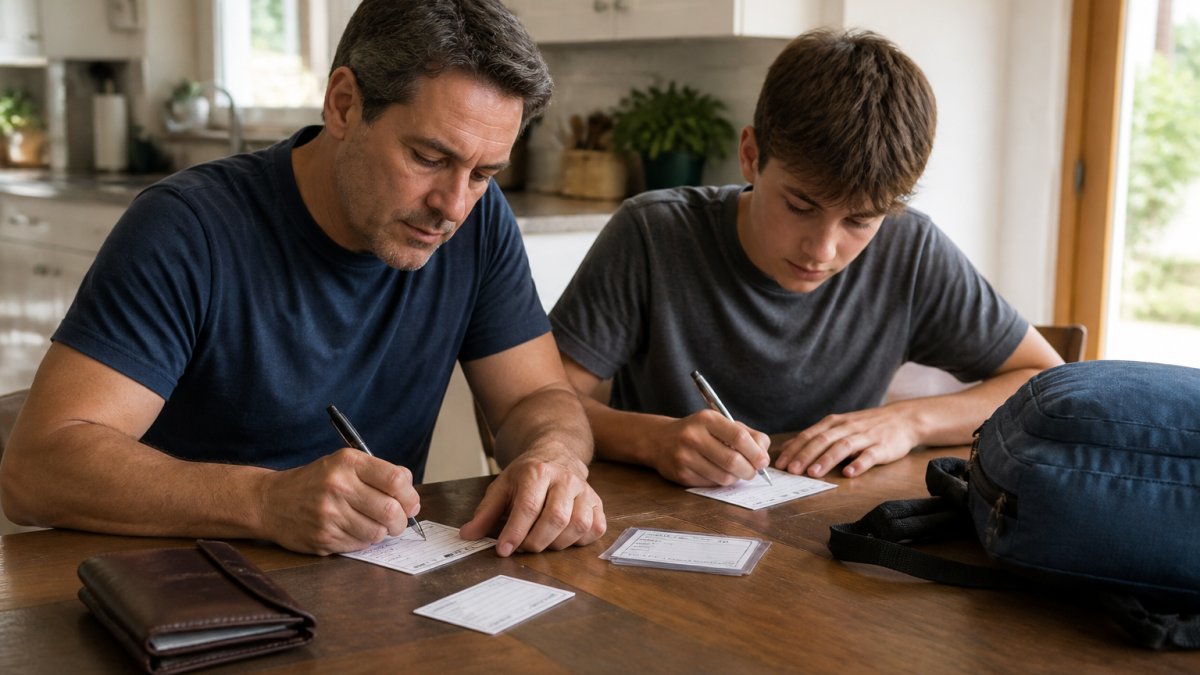
Make one for every family member, including kids. Laminate it or seal it in a small bag so it survives rain and wear.
An emergency contact card for family use works best when it is short: three to five numbers, the out-of-area contact, and one meeting place. Anything longer gets ignored under stress.
Step 6: Build an Emergency Communication Plan for Kids
Children need their own version of the plan, in language they can actually use.
Teach kids three things:
- Their own address and a parent's phone number
- The name and number of the out-of-area contact
- Where to go if they are at school when something happens
Review the school's emergency procedures with your child. Ask where students gather and how parents are notified.
An emergency communication plan for kids should be simple enough for a child to repeat from memory. If they cannot explain it back to you, it is too complicated.
Step 7: Practice, Review, and Update the Plan Every Six Months
A plan you never practice is a plan you will fumble. Set two review dates a year and treat them like appointments.
At each review:
- Call or text every number on the list to confirm it still works
- Update addresses, schools, and jobs
- Replace worn contact cards
A simple routine for maintaining your plan keeps it current without much effort. Pick dates you will remember, like daylight saving changes, and stick to them.
Your Next Step Toward a Plan That Holds Up
The hardest part of long distance planning is not the distance. It is turning good intentions into a written plan your whole family can follow under stress.
Our survival guide and workbook for shelter-in-place scenarios gives you structured checklists to fill in, not just advice to read.
Get started with Preppi Prepper.
Frequently Asked Questions
How do you make a family communication plan for emergencies when everyone lives in different states?
Start by collecting every household member's phone number, address, school or workplace, and doctor into one contact list. Then pick one out-of-area emergency contact who lives outside all of your regions. Write down two meeting places: one near each household and one central spot for reunification. Set a check-in window in each person's local time, agree on a text-first rule to reduce network congestion, and print a paper copy of the family communication plan for every household.
What should an emergency contact card for family members include?
An emergency contact card for family should list the out-of-area emergency contact first, then each household member's cell phone number and the family meeting place. Add the name and number of a trusted neighbor or local contact near each home. Keep the card small enough for a wallet or backpack pocket, laminate it, and store a photo of it on every phone. Update the card whenever a number or address changes.
What should you do if phone calls and text messages are not going through?
Send a text instead of calling. If texts fail too, try a data-based app, then a landline or a payphone, and finally the out-of-area contact as a relay point. Keep a paper copy of the contact list.
How often should a family practice its emergency communication plan?
Run a practice check-in, and review the plan whenever a phone number, address, school, or job changes. A simple drill works: everyone texts the out-of-area contact at an agreed time, then confirms they know both meeting places and where their emergency contact card is stored. After each drill, review the family communication plan template and correct anything that failed.
